Porro prism - Binoculars
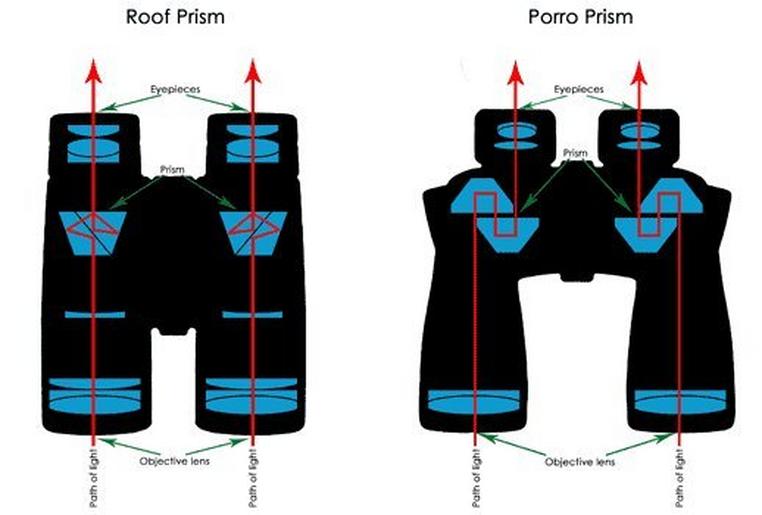
The prism in binoculars ensures that the image is always projected in an upright position. The prism also folds the light path so that the overall length of the binoculars is shortened and the binoculars are more compact in size.
A Porro prismis somewhat simpler to make than a roof prism. In Porro prism binoculars, the front objectives are not in line with the oculars, making them larger in size than roof prism binoculars. The advantage with Porro prism binoculars is that the impression of depth is somewhat better than with roof prism binoculars. After all, we see depth because each eye sees a slightly different image thanks to the interpupillary distance. If this interpupillary distance increases, the impression of depth also increases accordingly.
With Porro prism binoculars, focusing is done by moving the ocular. This causes 'changes in volume' to occur in the binoculars, allowing air to shift in or out during focusing. With roof prism binoculars, focusing is done by moving a lens (group) in the binoculars. This makes it far easier to make roof prism binoculars dust-free and watertight.
In spite of the fact that it is somewhat simpler to construct Porro prism binoculars than it is to construct roof prism binoculars, manufacturers are able to produce both these types of binoculars of comparable quality. Yet, in the higher segment, the majority of binoculars are constructed with roof prisms.